Hello again!
I hope you enjoyed Part 1. There’s one category left for today, and that’s The Perplexing. My first example is pretty self-explanatory in its perplexing-ness, however, with the last two items on my list, I should specify that it’s not necessarily the activity itself that leaves me scratching my head—it’s the level of commitment to it. Germans, I have questions. 😂 Let’s get after it!
The Perplexing
Washers & Dryers: I am officially not a fan of European washers and dryers. They are half the size of American machines, and the cotton cycle on each takes approximately 3½ hours. Yes, you read that correctly. Three and a half hours. Per machine. So, if I want to wash and dry a load of sheets or towels, I’m looking at about seven hours—and here’s the part that really gets me: at the end of those seven hours, the towels will still be damp and need some additional line drying!
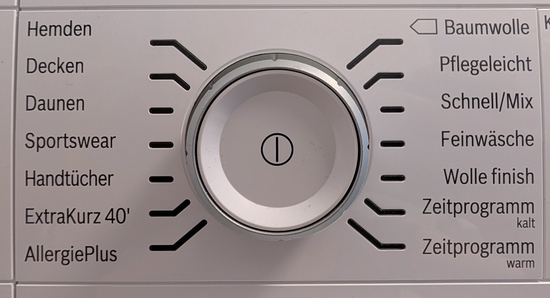
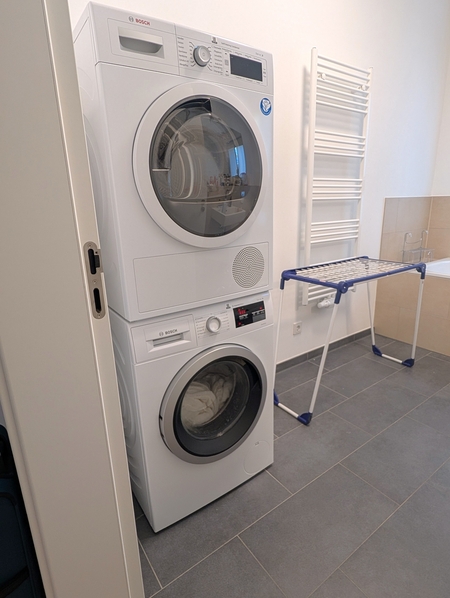
And before anyone assumes I am doing laundry with some sort of ancient machine from 1987, we have Bosch appliances that are only two years old. These are not relics. This is apparently just…how we do laundry here. I assume there is some perfectly logical explanation involving electricity, energy efficiency, European engineering, or possibly a secret German laundry philosophy that I have yet to understand. If you know why this is the way it is, please fill me in! The end result is that I now do smaller loads almost every day, which means there is pretty much always a washing machine or dryer humming somewhere in the background. Speaking of noise, that brings me to my next item…
Ruhetag & Ruhezeit: roughly translate to “day of rest” and “quiet hours,” and Germany takes both concepts quite seriously. There are country-wide quiet hours from 10 PM to 6 AM every day of the week and on Sundays and holidays, the whole day is a designated quiet day. All grocery stores are mandated to be closed on Sundays/Holidays and most other businesses close with the exception of tourist sites, museums, and a handful of cafes.
Certain activities are to be avoided on Sundays and holidays. That includes things like vacuuming, mowing, doing noisy home repairs, hammering, playing loud music, or generally making enough noise that your neighbors know exactly what you’re up to. I have even read that if you want to throw a party in your apartment that goes past 10 PM, it can be a good idea to give your neighbors a heads-up—or, depending on the circumstances, get their agreement in advance.
Now, I completely understand the appeal of this. In fact, there are moments when I think the United States could probably benefit from a little more Ruhe. But coming from a culture where you can run to the grocery store at 10 PM, vacuum whenever you feel like it, and start a home improvement project on a Sunday afternoon without giving it a second thought, the adjustment has been hard. I’m so used to having everything available whenever I want it that Sundays here cause me a surprising amount of low-grade anxiety. I think part of it is that I’m accustomed to making Sunday a productive day—laundry, errands, grocery shopping, cleaning, catching up on everything I didn’t get done during the week. Here, the entire system seems designed to gently look at you and say, “No. Sit down and rest.” And honestly? Maybe I need that. I suspect this is one of those things I’ll eventually learn to appreciate once I stop trying to turn Sunday into Tuesday.
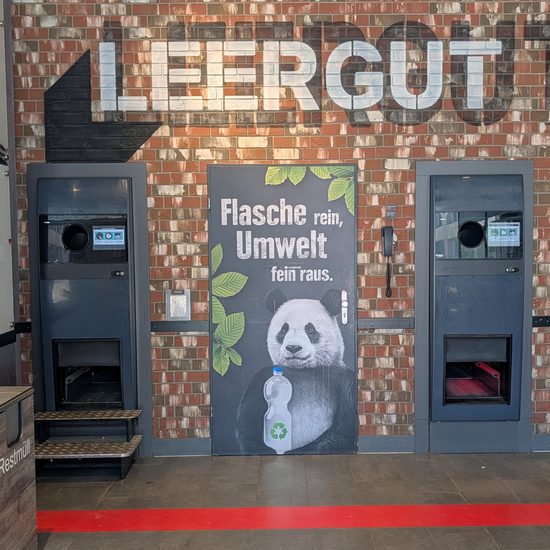
Waste Disposal & Recycling: I am a big proponent of taking care of our planet, and I genuinely appreciate Germany’s commitment to recycling and waste reduction. That said, Germany has taken recycling to a level that occasionally makes me feel like I need a minor in waste management. There is a very specific system for disposing of just about everything. For certain plastic and glass beverage bottles, the grocery store charges a Pfand, or deposit, when you purchase the item. You save your bottles and eventually take them back to the grocery store, where you feed them—one by one—into a very impressive bottle-return machine. The machine scans them, accepts some, rejects others with what feels like personal judgment, and then prints out a receipt giving you credit toward your next purchase. Depending on the bottle, the deposit can be anywhere from roughly 9 to 29 U.S. cents. The rejects, however, can’t be simply tossed with mixed recyclables. No, no, no. That bottle has a different destiny. More on that later.
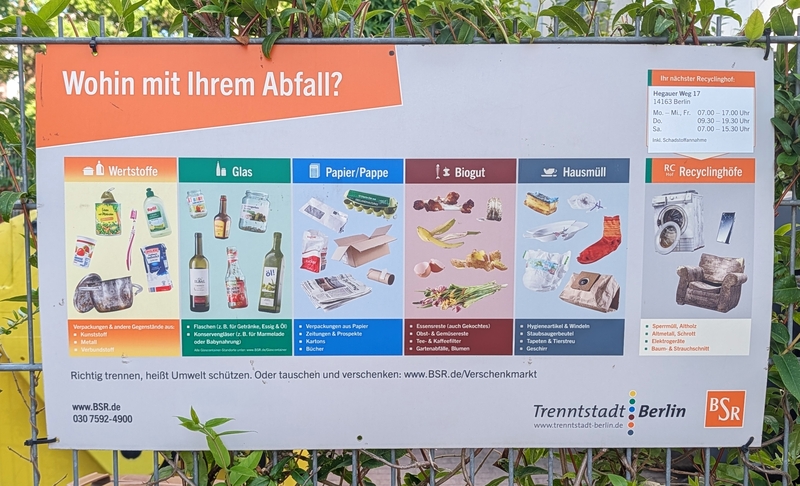
Which brings me to the recycling bins at our apartment complex. We have a whole collection of them, each tucked behind a locked sliding door. Yes, locked. I still have questions about why we need to secure the recycling and garbage, but I assume there is a very good German reason for this that I have yet to discover. Thankfully, the instructional sign has pictures, because otherwise I would still be standing there trying to figure it out. There are separate categories for general trash, mixed recyclables (plastic/aluminum/metal), paper, household waste such as appliances and electronics, glass, and biowaste.
And remember those bottles that the grocery store machine rejected? Turns out our apartment complex doesn’t have a glass recycling bin. That means I get to walk about 10 minutes down the street to yet another collection point. But wait! We aren’t done. At the glass collection point, I can’t simply toss all the glass into one giant container. Oh no. The glass must be separated by color: Green. White. Brown. And don’t even think about dropping glass off on Sundays (because Ruhetag, of course!).
Then we have the biowaste. I purchased my very first compost bin here, which I am trying very hard to embrace. I find the whole thing a little gross though, so I empty and rinse it every day. It is cute though, and I love that I can push stuff off my cutting board right into it!
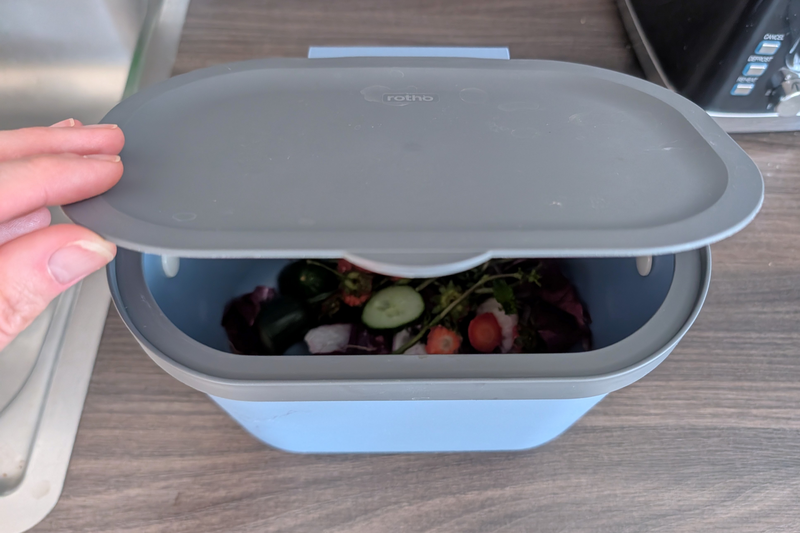
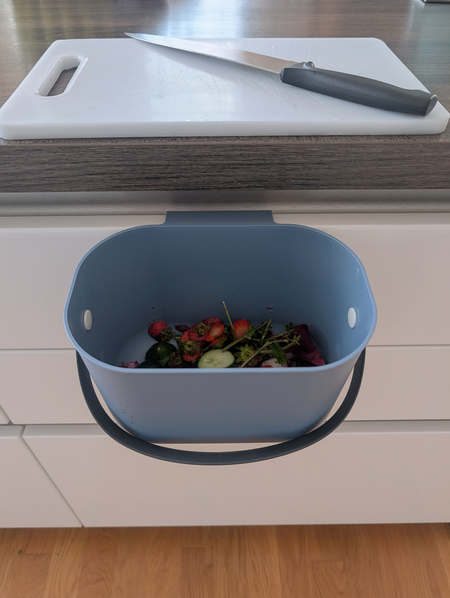
Honestly, it is kind of amusing that this has become one of my biggest stressors so far in Berlin. During our first few days here, a small mountain of trash and recyclables accumulated on our kitchen counter because we couldn’t figure out which of the approximately eight possible bins everything belonged in. We were genuinely afraid that we’d put something in the wrong container and immediately be reported to the German Recycling Authorities. (I’m kidding. Mostly.) Surely this could be simplified just a little, right? Probably not. So, I have accepted my fate. I now devote a small portion of every day to managing our household waste and making sure everything ends up in its proper location. :)