Hello friends – We just crossed the three-month mark in Berlin! Aside from a nasty sinus infection I’ve been battling for the last ten days, things have been feeling pretty good lately. Our apartment is slowly coming together—not quite finished yet, of course—and we are slowly but surely finding our places and people.
If you’re anything like me, you set expectations based on what you’ve experienced before. Naturally, I assumed Berlin’s winter daylight would feel pretty similar to Minnesota and Almaty, so I was caught off guard by how short our days are getting. Granted, it’s not Scandinavia-level dark, but we’re getting roughly an hour less daylight than Minnesota and Almaty right now. That got me curious about how Berlin and Minnesota stack up latitudinally, so here’s a handy graphic to put it into perspective.

Berlin sits about 7.5 degrees (roughly 520 miles) north of Minneapolis—closer to the latitude of Edmonton, which is how I figured out where to place the star. It’s much farther north than I’d pictured! Meanwhile, Almaty sits at roughly the same latitude as Minneapolis, which explains why winter daylight there felt familiar. Right now, the sun comes up around 7:30 AM and sets just after 4:00 PM. Come the winter solstice, we’ll be down to just 7 hours and 38 minutes of daylight! No wonder everyone kept telling us to plan a sunny escape to survive the winter—we took the hint and booked a trip to the Canary Islands for December.
The silver lining is that temperatures here are much milder. Even in January, the coldest month of the year, average highs sit around 38°F and lows hover near 30°F. Thank goodness, because years in warmer climates have turned me into a total cold-weather wimp. 😊 Jury’s still out on whether trading extra daylight for less bitter cold is a fair trade in the end.
Alright, enough weather talk. You know you’re Minnesotan when… ha!
One of the things I love most about Berlin is the sheer independence given to young people. I vividly remember one of our very first mornings here: Nick, Nia, and I were standing at a public bus stop waiting for Nia’s school bus to arrive. There were around 30 kids clustered on the sidewalk, and I remember thinking, Wow, that’s a pretty big group for one bus, and, where are all the parents?? Then, to my complete surprise, a regular city bus pulled up, and 20 of those kids casually hopped on—with zero parents in sight. I have to admit, I did not see that coming!
I came to learn that International schools are pretty much the only ones that use private buses here, I guess to accommodate their expat populations who would balk at putting their elementary or middle schoolers on the metro or a city bus. In fact, traditional yellow buses don’t even exist in Berlin—Nia rides to school in a coach bus!
That independence is easily one of the biggest cultural differences we’ve noticed. Starting around age eight, local kids are trusted to navigate the commute to school on their own via bike or public transit. Even now, it still catches me off guard to see a pair of eight-year-olds sitting on the U-Bahn, goofing off and watching TikTok videos on their phones, only to suddenly notice their stop, say a quick goodbye to their friends, and hop off right on cue. Honestly, from age eight on up, you’re far more likely to see kids traveling in packs with other kids than tethered to a parent. You see them on trains, walking, biking, and scooting everywhere—usually in groups, entirely running their own show. It really is something.
At age 14, we had just let Nia ride the D.C. Metro on her own this past summer—and even then, it wasn’t truly solo, because we required her to go with a friend. When we arrived in Berlin, we had to figure out our new boundaries for letting her navigate the city alone or with peers. Riding the Metro in D.C., where maps are straightforward and everything is in your native language, is one thing. Here, the stops, transit announcements, and street signs are all in German. Plus, getting around often means transferring from an underground train to a surface bus, which requires exiting a station, finding the correct stop, and figuring out which direction the bus is actually heading. (For the record, I cannot tell you how many times I have hopped on a bus going the exact wrong way!)
We eased Nia in with the commute home from school. One afternoon, she needed to stay late and would miss the activity bus. We decided to let her try it alone since we’d already taken that exact route together, and she knew both the ten-minute walk from campus and which bus stop to use. It was the ideal training-wheels trip: zero transfers, and the bus dropped her off right outside our front door. She repeated that route a handful of times over the first couple of months until it became second nature. From there, we introduced her to the local transit apps and started putting her in charge of navigating whenever the three of us went out together as a family.
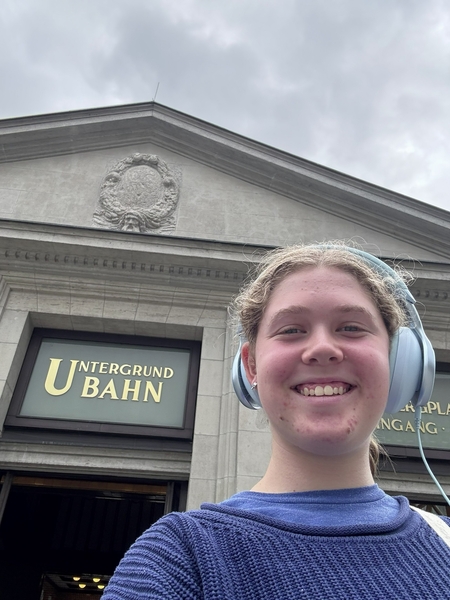
Over the past month, she has taken things to a whole new level. Last Saturday, she took an hour-long trip downtown all by herself to spend the afternoon sketching at a museum (so delightfully European, right?). Along the way, she had to transfer between transit lines, troubleshoot a service delay, and ask a stranger for help in German—and she still got herself there and back without a hitch. And this week, she’s navigating her way to three different venues across Berlin for her Model United Nations conference!

It’s wild how something that felt deeply nerve-wracking to all of us back in September now feels like no big deal at all. Even better, we can visibly see the boost it’s given her confidence, along with the real-world problem-solving skills she’s building every time a bus gets rerouted or delayed and she has to figure things out on the fly.
Of course, the next major parenting decision-point is already looming on the horizon: whether or not to let her drink beer and wine when she turns 16 next October. In Germany, teens can’t drive until 18, but at 16, they’re legally allowed to buy and drink beer and wine. I’m still not entirely sure how I feel about that milestone yet—but if our transit strategy is any indication, I’m sure we’ll approach it the exact same way: with a slow, steady build-up until we’re all comfortable with the newfound freedoms of being a teen in Berlin.